





Setting Yourself Up for Success

Work with your doctor to create the right program for you. Every person has unique exercise and health needs, and the particulars of your disability will influence how you should approach exercise. Some exercises can exacerbate certain conditions, while others can be extremely helpful. Meet with your doctor to discuss appropriate exercises for your situation. For example, water exercise is often recommended for sufferers of fibromyalgia. Exercise is beneficial for everyone, regardless of any disabilities. The important thing is to create the right exercise program for you—and that means relying on the advice of experts like your doctor.
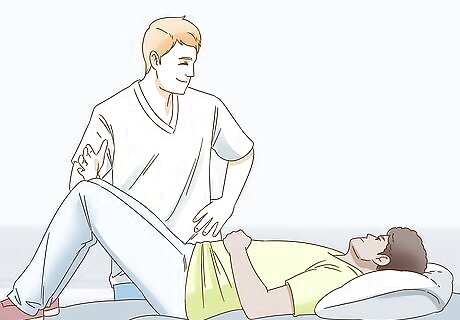
Learn proper exercise techniques by attending physical therapy sessions. Good form is always important when exercising, and can be especially important if you have a disability. A physical therapist, whether prescribed by your physician or sought out on your own, can tailor an exercise regimen that’s suited to your condition. Whenever possible, choose a physical therapist with expertise working with patients who have similar disabilities to yours.
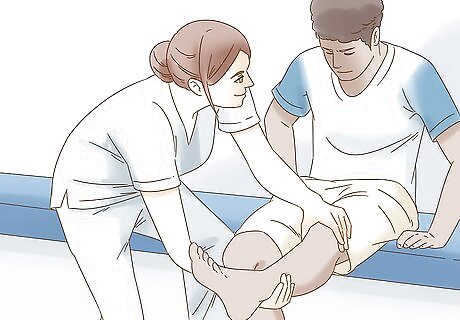
Utilize a trainer or helper when you exercise. Depending upon your disability, this could be a personal trainer, a physical therapist, a physical therapy aid, a nurse, or, in some cases, a friend or relative. This person can make sure that your doctor- and physical therapist-recommended exercises are being done properly and safely. Depending on your condition, you may be more susceptible to injury during exercise, especially if you use improper technique. In this case, it’s especially important to have a helper when you exercise.
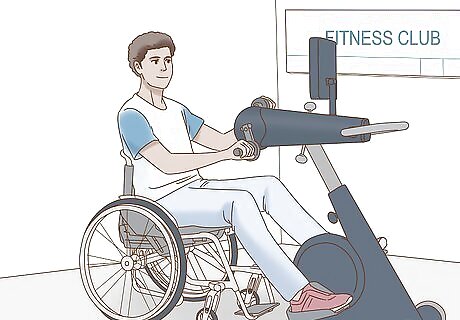
Find a disability-friendly fitness club for your workouts. Look for a gym that has a pool, personal trainers or aides, and disability access for exercise equipment and areas. Signing up for a membership will likely be the most cost effective way to do regular workouts. Take a tour of the facility beforehand to make sure you’ll feel comfortable there, and to make sure that they have suitable, accessible equipment for your needs. For instance, if you need a lift chair to get in and out of the pool, does the gym have one that’s in good operating condition? While it’s probably a more pricey option, you might also hire a personal trainer to come to your home for workouts. Depending on your fitness level and exercise needs, however, you may also need to invest in multiple pieces of accessible fitness equipment.
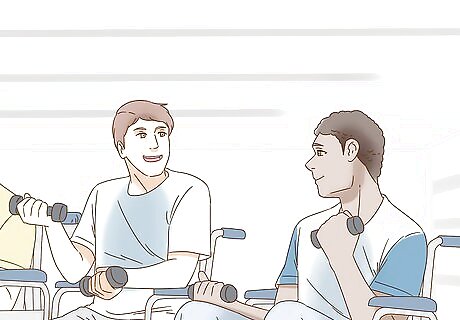
Join or start a disability exercise group if you need motivation and support. Such groups may be available through local hospitals, clinics, gyms, or community centers. Search online and on community boards, or put out a flier and see if there is a need in the community. If you do find you have a number of other disabled people who want to start an exercise group, contact local pools, gyms, or community centers to see if they would be interested in holding classes. Some people feel more comfortable and confident if they exercise alongside others with similar disabilities.
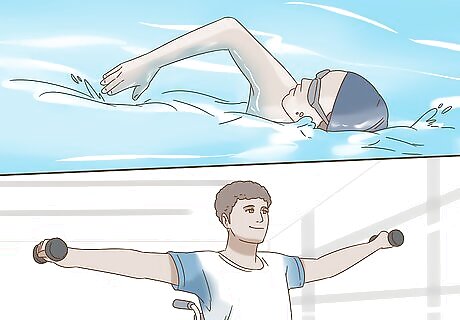
Set short-term and long-term goals to stay motivated. Work with your doctor, physical therapist, and/or personal trainer to set goals that are appropriate for you. By creating goals that are challenging but achievable, you’ll be motivated to continue with your exercise program. For instance, a short-term goal may be to swim for 15 minutes at a time, 3 days per week. A long-term, lifestyle goal may be to get 30 minutes of exercise every day.
Adding Variety to Your Exercise Program
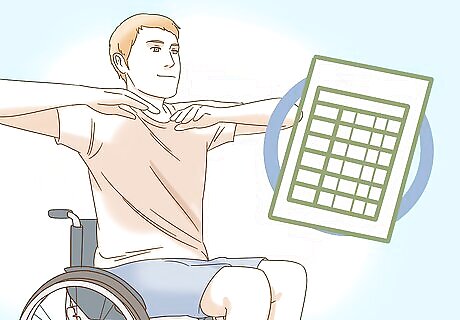
Follow your doctor’s guidance for building up your exercise program. Especially if you have been physically inactive, it’s important not to jump straight into a full-on daily exercise routine. Under the guidance of your doctor and physical therapist, slowly build up the amount of time you exercise over a period of weeks or months. It’s possible that your end goal will be to exercise for 30-45 minutes per day. To get there, you might start out by exercising 10 minutes per day, and add 5 minutes per day each week. If you feel moderate or significant soreness, you’re probably exercising too much or too hard and need to dial back. If you feel pain, stop exercising and contact your doctor. If you experience chest pains or trouble breathing, get medical help right away.
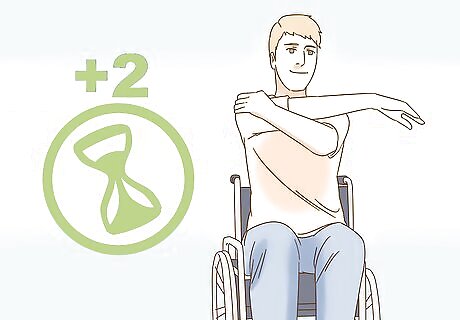
Include 2-plus hours of aerobic exercise in your weekly program. Aerobic (or cardiovascular) exercise works your heart and lungs, and includes activities like walking, swimming, and cycling (by foot or hand). In general, adults should aim for 150 minutes of aerobic exercise per week. Ideally, you should break up your aerobic exercise time into 4-5 weekly sessions that last 30 minutes each. Talk to your doctor to determine if your goals should be different due to your particular circumstances.
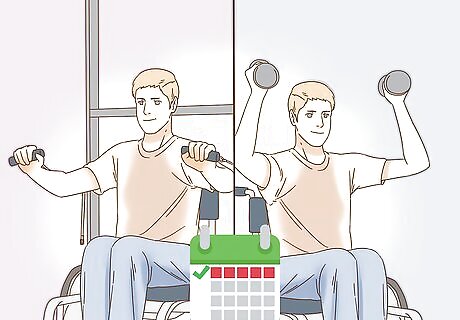
Schedule 2 strength training sessions per week. Strength training utilizes weights or resistance bands to improve your muscle strength and bone density. You can work out with free weights or weight machines at a gym, or use hand weights or resistance bands at home. Strength training sessions can last from 20-45 minutes. Schedule at least 1 aerobic and/or flexibility day between strength training sessions.
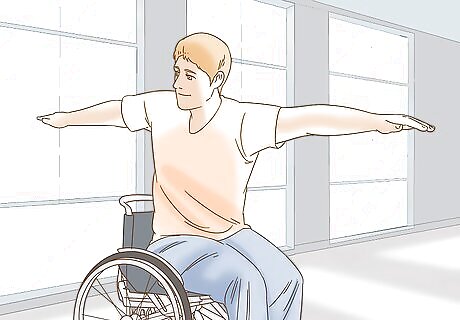
Add multiple flexibility training sessions to your weekly schedule. Flexibility training, such as yoga and tai chi, can improve your balance and coordination and it will also help you to manage your stress. You can do flexibility training as often as every day of the week, but try to fit in at least 2 sessions per week. You might, for instance, schedule 30-minute aerobic exercise sessions for Monday, Tuesday, Thursday, and Friday, strength sessions for Wednesday and Saturday, and flexibility sessions for Tuesday and Saturday. Don’t overdo it though! Give yourself a day off from your routine each week.
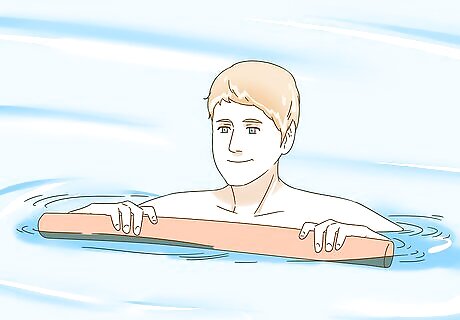
Exercise in water to aid your stamina and range of motion. People with spinal issues, nerve problems, or limited use of one or more limbs often find the added buoyancy of water to be helpful. If possible, look for water exercise classes that are geared specifically toward people with mobility issues or other disabilities. Even if swimming is not possible for you, doing water aerobics or walking in water (with the aid of a weight belt) may be suitable for your circumstances. Talk to your doctor regarding the best options for you.
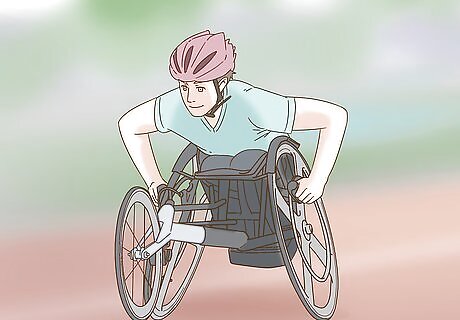
Take part in modified team or individual sports as part of your cardio program. Many sports can be slightly modified to make them more accessible to individuals with various disabilities. For instance, wheelchair-friendly sports include basketball, tennis, track and field, boccia, soccer, and swimming. Making sports part of your exercise routine adds variety and may help maintain your dedication. Sports also give you the opportunity to interact with others who may or may not share your particular disability. You may end up making a few exercise buddies!
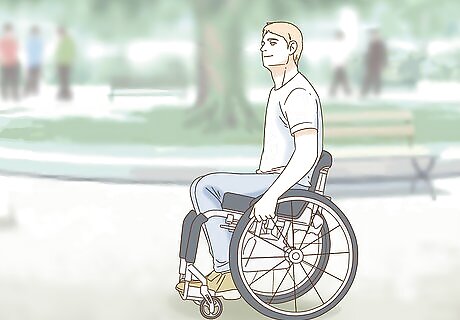
Include non-structured exercise as part of an active lifestyle. In addition to traditional exercise routines, look for everyday ways to be physically active. Depending on the nature of your condition and your particular fitness needs, activities like cleaning the house or doing some gardening can complement your exercise program. If you have both a powered and a manual wheelchair, for example, using the manual wheelchair to take a trip around the neighborhood with a friend after dinner can provide 15-30 minutes of aerobic exercise. Consult with your doctor and physical therapist regarding everyday activities that you should and should not attempt, based on your particular circumstances.
Seated/Wheelchair Exercise Examples
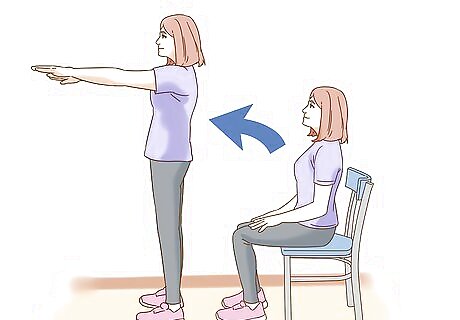
Try sit-to-stand exercises if you have reduced mobility in your legs. Sit at the front edge of a sturdy chair with your back straight and your feet flat on the floor. If you are able, stand upright using only your legs. Otherwise, place your hands on your knees to help boost yourself up, or use an anchored grab bar or a sturdy table to help pull yourself up. Slowly sit back down and repeat. Unless otherwise directed by your doctor or physical therapist, aim to build up to 3 sets of 10-12 repetitions. This exercise can help to build leg strength and improve your balance. Don’t try this or any other new exercise without talking to your doctor first, however.
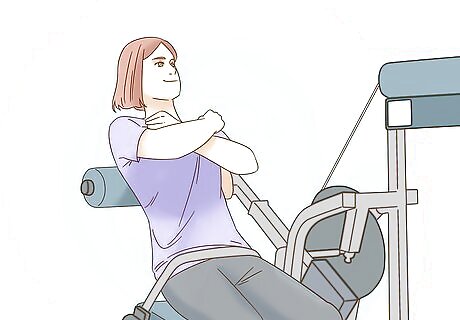
Do seated back extensions to build lower back and abdominal strength. Sit upright in your wheelchair or another sturdy chair, and place your hands next to your ears. Bend slowly at the waist, keeping your lower body and head still and your back straight. Bend slowly until you are parallel to the floor, then slowly raise yourself back up to the starting position. Build up to 3 sets of 10-12 reps, if recommended by your doctor. Exhale as you bend down, and inhale as you come back up.
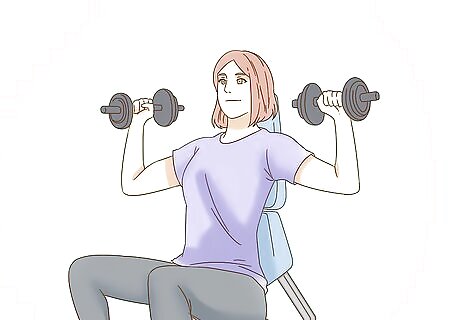
Build upper body strength with seated shoulder presses. Sit upright in your wheelchair or another sturdy chair. Hold a hand weight in each hand, positioned to the side of each ear and with your closed palms facing forward. Lift the weights straight up until your arms are fully extended, then bring them back down to the starting position. Alternatively, you can use elastic fitness bands instead of hand weights. Either sit on a long fitness band and hold each end in your hands, or tie 2 fitness bands securely to the arm rests of your wheelchair. For strength-building, use heavier weights (or bands with more resistance) and aim for 3 sets of 10-12 reps. However, don’t try to lift more weight than you can handle comfortably. For aerobic exercise, use lighter weights (or bands with less resistance) and aim for 3 sets of 20 reps. Take 1 second to raise the weights and 2 seconds to lower them with each rep.
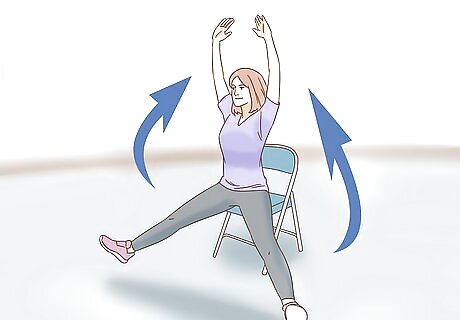
Give seated jumping jacks or air boxing a try as aerobic exercise. For seated jumping jacks, sit upright in your chair or wheelchair, with your hands lowered to your sides. Keep your arms straight and raise them up over your head so that your open palms clap together, then lower them back down to your side and repeat. Take 1 second to raise your arms and 2 seconds to lower them, and aim for 3 sets of 20 reps. For air boxing, simply practice doing various punching moves with both arms while seated. Aim for 3 sets of 30 seconds apiece.
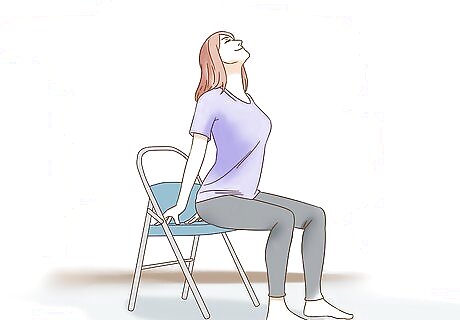
Take a seated yoga or tai chi class for flexibility training. Many common yoga and tai chi maneuvers can easily be adapted to suit people who have mobility issues or who utilize a wheelchair. Both yoga and tai chi will improve your flexibility, and they’re also great ways to reduce stress. Plus, if you take part in a class, you’ll get to socialize with others at the same time. If possible, build up to doing 30 minute sessions 2-3 times per week. You may even be able to make it a daily routine.









Comments
0 comment